CLSG

Cognitive Learning in Science Group
Contact(s): 
Clement, John

The Conceptual Learning in Science Group has been engaged in science education research activities since the late 70's, with the help of Professors Randall Phillis, Biology, UMass Amherst, Melvin Steinberg, Physics, Smith C., and Neil Stillings, Cognitive Science, Hampshire C., and many doctoral students, postdocs, and local school teachers. Our work has focused on analogies, misconceptions, useful intuitions, creativity and imagery use in experts, model based learning, discussion leading strategies, computer simulations, and other topics. The group has been funded virtually continuously during this period by the US National Science Foundation.

Latest CLSG News

03/20/2012 - 12:29pm

Four members of CLSG presented a related paper set at the Annual International Meeting of NARST in Orlando Florida. The title of the set was Discussion-Based Teaching Strategies to Support Mental Modeling: Animated Images, Static Images, and Mental Imaging. Presenters were Grant Williams, Norm Price, Abi Leibovich, and Lynn Stephens and Phil Scott was discussant.

01/17/2008 - 7:07pm

John Clement and colleagues have three new books out.

11/27/2007 - 2:50pm

SRRI's own John Clement has received the Distinguished Contributions to Science Education Through Research Award from the National Association for Research in Science Teaching (NARST).

Current CLSG members

Marlon Adams Undergraduate assistant
Stephens, A. Lynn Post doctoral researcher
Leibovitch, Abigail Ph.D student, School Psychology
Price, Norman Ed.D student, Mathematics, Science, and Learning Technologies
Clement, John Professor of Education

CLSG publicatons (reprints, preprints, technical reports, etc.)

See the SRRI publications list.

Current CLSG projects

Visual Modeling Strategies in Science Teaching

Finding principles of instruction for developing students' visualizable models in science
This NSF-funded project seeks principles of instruction for developing students' visualizable models in science, including design principles for curriculum development, technological tools, and new pedagogical principles.

Model Construction Processes in Experts

This project complements and provides input to our visual modeling strategies in science teaching project by attempting to understand model construction and learning processes in expert scientists, with an emphasis on the roles of analogy, imagery, and thought experiments.

Published CLSG "products"

Creative Model Construction in Scientists and Students: The Role of Imagery, Analogy, and Mental Simulation

This monograph presents a theory of creativity and imagery-based conceptual learning in science that was developed on the basis of think-aloud protocols from experts and students.

Model Based Learning and Instruction in Science

This book is a collection of chapters by our research team describing new, model-based teaching methods for science instruction. It presents research on their characteristics and effectiveness, exploring them in a very diverse group of settings: middle school biology, high school physics, and college chemistry classrooms.

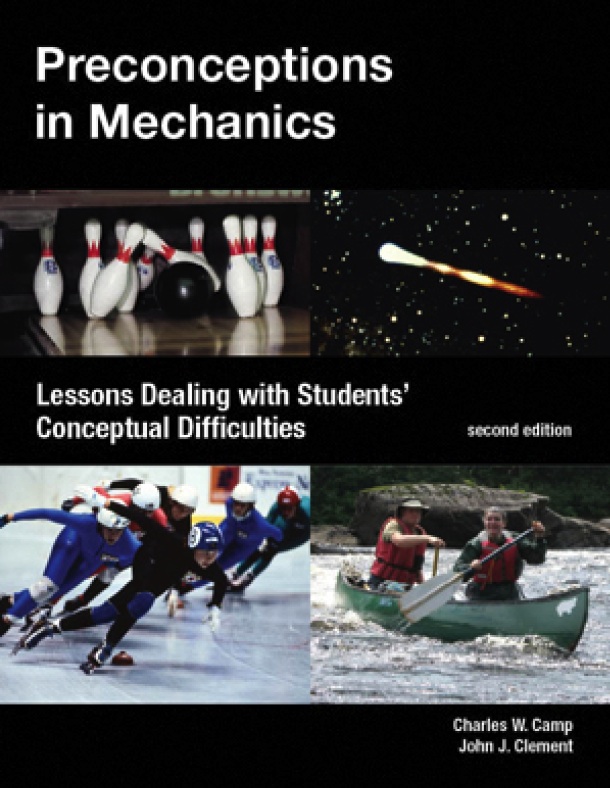
Preconceptions in Mechanics

Lessons dealing with conceptual difficulties

by Charles Camp and John Clement. Contributing authors: David Brown, Kimberly Gonzalez, John Kudukey, James Minstrell, Klaus Schultz, Melvin Steinberg, Valerie Veneman, and Aletta Zietsman. College Park, MD: American Association of Physics Teachers. Second Edition 2010.

The nine units in this high school physics curriculum focus on areas where students have exhibited qualitative preconceptions --- ideas that they bring to class with them prior to instruction in physics. Research has shown that certain preconceptions conflict with the physicist's point of view. It has also shown that some of these conflicting preconceptions are quite persistent and seem to resist change in the face of normal instructional techniques. The motivating idea for this book is to provide a set of lessons that are aimed specifically at these particularly troublesome areas and that use special techniques for dealing with them. Ideas in the lessons can be used to supplement any course that includes mechanics.