
SERG

Statistics Education Research Group
Group Page: 
SERG
Contact(s): 
Konold, Cliff

SERG is a group of researchers with backgrounds in psychology, education, and computer science who have been collaborating since the late 1970's. The group's mission is to better understand how people reason about probability, statistics, and data analysis, and to use this understanding to improve the teaching of these topics at both the university and K-12 levels. Research initially focused on how adults reason about statistics and probability before receiving any formal instruction. More recent work has focused on younger students learning about data and chance and how their understanding develops over instruction in technology-rich environments.

Latest SERG News

02/26/2013 - 3:22pm

We are looking for a Javascript/Actionscript Game Programmer (Departmental Assistant) to join our development team for short term, on-site work in our game lab at the Scientific Reasoning Research Institute (SRRI), UMass Amherst.

02/25/2013 - 12:00am

Student Game Programmers Wanted: We are putting together a small team of Javascript/Flash/Actionscript student programmers to further develop and polish several educational games for Mac/Windows/iPad.

12/03/2012 - 11:43am

The new version of TinkerPlots (TinkerPlots 2.1) has been released.

Most importantly, we've made TinkerPlots 2.1 a lot more stable. We've fixed a large number of bugs, both major and minor.

11/13/2012 - 11:45am

Cliff Konold visited Joan Garfield's Statistics Education group at the University of Minnesota. See their blog post.

11/13/2012 - 11:39am

Cliff Konold gave a presentation about the Data Game project at MIT to the RELATE group

Current SERG members:

Konold, Cliff Director of SRRI & Research Associate Professor
Mike Salyh Game Programmer
Russ Phelan Game Programmer
Ryan McCann Game Programmer
Miller, Craig D. Software Project Manager
Kreetong, Kosoom (Jang) Ed.D student (Mathematics, Science and Learning Technologies), Webmaster

SERG publicatons (reprints, preprints, technical reports, etc.):

See the SRRI publications list.

Current SERG projects:
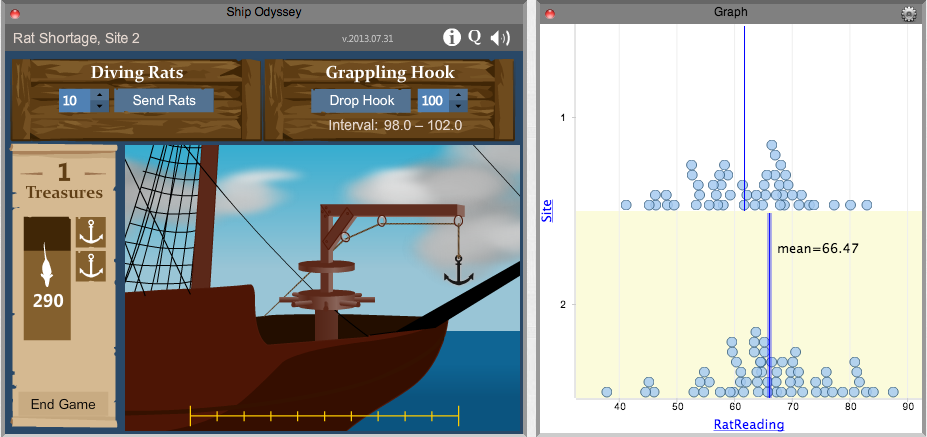
Data Games

Tools and Materials for Learning Data Modeling
Students playing computer games generate large quantities of rich, interesting, highly variable data that mostly evaporates into the ether when the game ends.

What if in a classroom setting, data from games students played remained accessible to them for analysis?

Past SERG projects:

Model Chance

Simulation software and classroom activities to help middle school students understand probability
Model Chance was a project funded by the National Science Foundation to develop simulation software and classroom activities to help middle school students learn about probability and data modeling. The simulation tool was integrated into our data-analysis software, TinkerPlots and was eventually released as TinkerPlots version 2.0.

TinkerZeum

Involving museum visitors in data analysis explorations
Funded by the National Science Foundation, the Tinkerzeum Planning Project was a one-year collaborative project exploring the feasibility of involving museum visitors in data analysis. These studies, which took place at the Museum of Science in Boston and at the Naismith Basketball Hall of Fame in Springfield MA, have helped us understand the kinds of data and exhibits that lead to compelling museum investigations and the types of additional supports visitors require to begin exploring data.

Data Modeling

Constructing data, modeling worlds: Collaborative investigation of statistical reasoning
This project aimed to change the way students -- and teachers -- think about math and science and was part of a larger endeavor by Peabody College to "reform the schooling of mathematics and science," said co-investigator and Professor of Science Education Rich Lehrer. This innovative project focused on learning rather than performance as the standard by which educational methods are judged.

ViSoR

Advanced visualization tools for understanding statistics
This project addresses the growing importance of data literacy as a fundamental skill for living in a democratic society and the disheartening fact that few people have a solid understanding of data. It addresses this need by studying how advanced visualization tools can affect teachers' and students' develop understanding of several crucial statistical concepts.

TinkerPlots Project

Developing tools and curricula for enhancing data analysis in the middle school
In the TinkerPlots project, funded by the National Science Foundation, we created a software tool and curriculum materials for teaching data analysis and statistics in middle schools.

Data Sharing

A Study of Student Investigations in Data-Sharing Projects
Overview The primary objectives of this research project were to a) identify the core ideas in rudimentary data analysis, b) research the methods students typically employ to compare two groups or judge the relationship between two variables, and c) identify features of data and tasks that we should attend to in designing instruction. Our research was aimed at informing teachers as well as the development of future data analysis projects, materials, software, and teacher development efforts.

Critical Barriers

Students Analyzing Data: A Study of Critical Barriers
This study was funded under the Small Grant for Exploratory Research Program at NSF.

ChancePlus

A Computer-Based Curriculum in Probability and Statistics
ChancePlus was a four-year project to develop and field test materials for teaching probability and statistics at the high-school level using computers.

S-CASTS

S-CASTS: System for Collaboration among Students, Teachers and System is a collaboration between UMass, TERC, and Artificial Intelligence researchers at Harvard. We are investigating the use of models of collaboration, especially as embodied in collaborative human-computer interface systems, in the augmentation of existing flexible software tools for mathematics education.

Research: Statistical Intuitions

Investigate statistical intuitions of college students
Understanding of Basic Statistical Concepts
NSF Grant BNS-8509991 (1985 - 88)

Cognitive Skills Underlying Statistical Inference
NSF Grant SED-8113323 (1981 - 85)

Program of Applied Research on Scientific Reasoning Processes
NSF Grant SED-8016567 (1980 - 83)

Role of Preconceptions and Representational Transformations in Understanding Science and Mathematics
NSF Grant BNS-8509991 (1978 - 80)

In these four projects We used primarily clinical interviews to investigate statistical intuitions of college students.

Published SERG "products":

DataScope

DataScopeĀ® was a Macintosh Classic data-analysis program from the 1990s with accompanying data sets and instructional activities for grades 9-13.

GrowAverage

Grow Average© was a Macintosh (Classic) program from the 1990s for demonstrating the Law of Large Numbers and the Central Limits Theorem.

ProbSim

Software and activities for teaching probability via simulations
Prob Sim was a Macintosh (Classic) program from the 1990s with accompanying instructional activities designed for teaching probability via simulations in grades 6-13.

TinkerPlots Software

Software for dynamic data exploration
TinkerPlots is a data visualization and modeling tool developed for use by middle school students and published by Key Curriculum.

TinkerPlots is especially useful for mathematics teachers striving to teach students data analysis in line with recommendations of the NCTM's Curriculum Standards, the Common Core State Standards for Probability and Statistics and to inquiry-based science classrooms where students collect and analyze data as part of formulating and testing their own hypotheses.